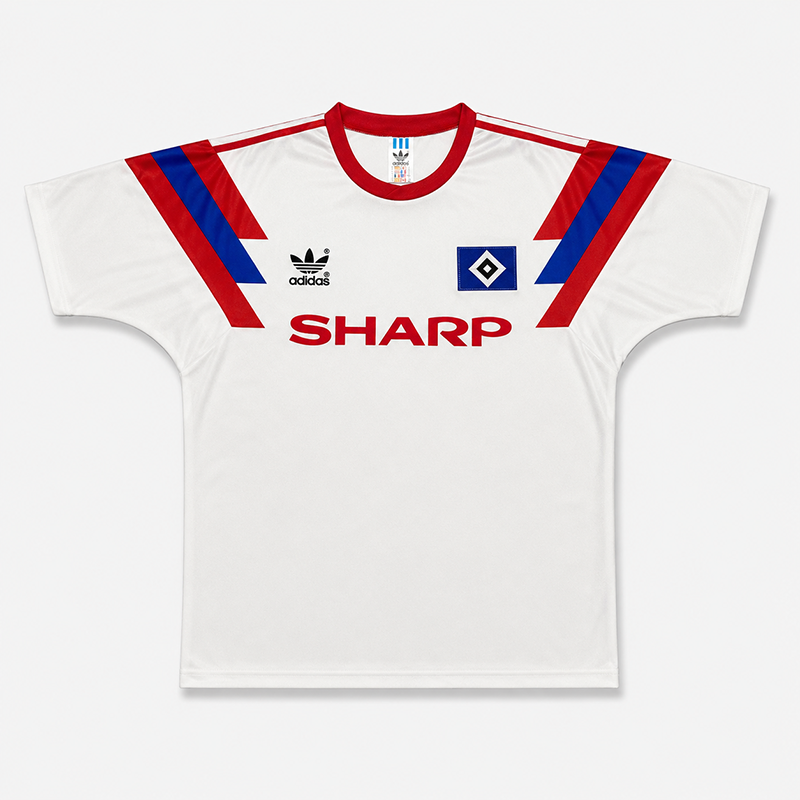
The Hertha BSC 2009–10 Home Retro Football Jersey represents a dramatic chapter in the history of the German capital's most established football club. Following an impressive fourth-place Bundesliga finish in 2008–09, Hertha entered the new campaign with European ambitions but endured a difficult domestic season that ended in relegation. Despite finishing 18th in the Bundesliga, the team enjoyed a memorable UEFA Europa League campaign, progressing from the group stage to the Round of 32 before facing Portuguese giants Benfica. The shirt captures a distinctive period in Hertha's history, immediately preceding the club's successful return to the Bundesliga in 2010–11.
The squad featured notable players including Raffael, Łukasz Piszczek, Adrián Ramos, Arne Friedrich, Pál Dárdai, Gojko Kačar and Cícero. Brazilian playmaker Raffael finished as the club's leading Bundesliga goalscorer with seven goals, while Piszczek continued his development before joining Borussia Dortmund in 2010. Captain Friedrich provided experience in defence, and Dárdai remained an important figure in midfield. These players make the 2009–10 season particularly interesting for collectors who appreciate both Hertha's club heritage and the early careers of future European football stars.
The home jersey features Hertha Berlin's traditional blue-and-white vertical stripes, creating the unmistakable appearance associated with the capital club. A classic white polo-style collar with subtle blue trim gives the shirt a refined late-2000s design, while contrasting red detailing adds a distinctive visual accent. The Hertha BSC club crest appears on the chest alongside the prominent Deutsche Bahn (DB) sponsorship, completing its authentic 2009–10 appearance. Combining traditional Berlin football identity with the historical significance of Hertha's Europa League campaign and a memorable generation of players, this retro home jersey is a distinctive addition to any collection of classic Bundesliga shirts.
Please refer to the size guidance on this product page for detailed measurements.
Hertha BSC 2009–10 Home Jersey
Buy 2 items & save 10% · Buy 4 selected tops & save 20%
Size Guidance (Retro Jersey)
Size Chest (in) Length (in) Rec. Height (ft/in) Rec. Weight (lb) S 39 28 65–67 121–132 M 41 28 67–69 132–154 L 43 29 69–71 154–176 XL 44 30 71–75 176–198 XXL 46 31 75–79 198–220 Note: All sizes are for reference only. Manual measurement may result in an error of ±1 inch.
IN BETWEEN SIZES?
That's easier said than done. Because what do you do if you are in between two sizes?
Well, that's up to you. Do you like a tight fit? Go for the smaller size. Loving a loose fit? Go for the larger size.
TOP FIT
If your body measurements for chest and waist result in two different suggested sizes, order the size from your chest measurement.
Rec. Player Printing Options
Hertha BSC used permanent squad numbers and player-name printing during the 2009–10 season, making full name-and-number combinations historically appropriate.
Best Printing Choice: RAFFAEL 10
Other Strong Options: PISZCZEK 26 / FRIEDRICH 3 / RAMOS 9 / DÁRDAI 8 / KAČAR 44
Printing
Recommendation
RAFFAEL 10
The strongest season-specific choice. Raffael scored seven Bundesliga goals, finishing as Hertha's leading league scorer and providing important creativity throughout the campaign.
PISZCZEK 26
An excellent early-career choice. Łukasz Piszczek made 31 Bundesliga appearances before joining Borussia Dortmund, where he later became one of Europe's most accomplished right-backs.
FRIEDRICH 3
A classic captain's selection. German international Arne Friedrich was Hertha's experienced defensive leader and represented Germany at the 2010 FIFA World Cup.
RAMOS 9
A strong attacking alternative. Colombian striker Adrián Ramos joined Hertha in 2009 and began a successful career in German football that later included Borussia Dortmund.
DÁRDAI 8
An outstanding club heritage choice. Pál Dárdai was one of Hertha's longest-serving players and later became an important figure in the club's coaching history.
KAČAR 44
A distinctive midfield selection. Serbian international Gojko Kačar was an important member of Hertha's squad and later represented Serbia at the 2010 World Cup.
Season Information
The 2009–10 season was one of the most dramatic and disappointing campaigns in Hertha BSC's modern history. After finishing fourth in the Bundesliga in 2008–09 and narrowly missing out on Champions League qualification, the Berlin club entered the new season with European ambitions.
However, a difficult domestic campaign, managerial changes and inconsistent performances ultimately resulted in relegation to the 2. Bundesliga.
Despite the disappointing league outcome, Hertha enjoyed a respectable UEFA Europa League campaign and featured several players who would later achieve considerable success in European football.
Bundesliga — 18th Place and Relegation
Hertha began the 2009–10 Bundesliga season under Swiss manager Lucien Favre, who had guided the club to an impressive fourth-place finish the previous year.
The team opened the campaign with a 1–0 home victory over Hannover 96 but subsequently suffered a prolonged series of defeats.
After a disappointing start, Favre was dismissed in September 2009. Assistant coach Karsten Heine briefly took charge before Friedhelm Funkel was appointed in October.
Despite the managerial change, Hertha struggled to recover.
The team finished 18th with just 24 points, recording five victories, nine draws and 20 defeats across 34 matches.
Hertha scored 34 league goals and conceded 56, finishing at the bottom of the Bundesliga table.
The result ended the club's 13-season consecutive stay in Germany's top division.
UEFA Europa League — Round of 32
Although Hertha struggled domestically, the club produced several memorable performances in the 2009–10 UEFA Europa League.
Having qualified through its fourth-place Bundesliga finish in 2008–09, Hertha entered the competition in the play-off round and eliminated Danish club Brøndby to reach the group stage.
Drawn alongside Sporting CP, Heerenveen and Ventspils, Hertha finished second in Group D and progressed to the knockout stage.
The team's European campaign included an important 1–0 away victory over Sporting CP in Lisbon, helping secure qualification for the Round of 32.
Hertha subsequently faced Portuguese giants Benfica.
After drawing 1–1 in Berlin, the German side suffered a 4–0 defeat in Lisbon, exiting the competition 5–1 on aggregate.
Despite the elimination, reaching the Europa League knockout stage provided a positive achievement during an otherwise difficult season.
Raffael — Leading Goalscorer
Brazilian attacking midfielder Raffael was one of Hertha's most influential players during the campaign.
Wearing the number 10 shirt, Raffael scored seven Bundesliga goals, finishing as the club's leading league goalscorer.
His creativity, dribbling and attacking movement made him a central figure in Hertha's forward play.
The squad also featured Colombian striker Adrián Ramos, who joined in the summer of 2009 and began establishing himself in German football.
Other important players included captain Arne Friedrich, Polish international Łukasz Piszczek, experienced midfielder Pál Dárdai, Serbian international Gojko Kačar and Brazilian midfielder Cícero.
Łukasz Piszczek — Before Borussia Dortmund
One of the most interesting historical connections to the 2009–10 Hertha squad is Łukasz Piszczek.
The Polish international made 31 Bundesliga appearances during the season, establishing himself as a regular member of the team.
Following Hertha's relegation, Piszczek joined Borussia Dortmund in the summer of 2010.
He subsequently became one of Dortmund's most successful modern defenders, winning Bundesliga titles and reaching the 2013 UEFA Champions League final.
The 2009–10 Hertha home jersey therefore represents an important early chapter in Piszczek's career, alongside the club's final Bundesliga season before its immediate promotion back to the top flight in 2010–11.